Paying users first
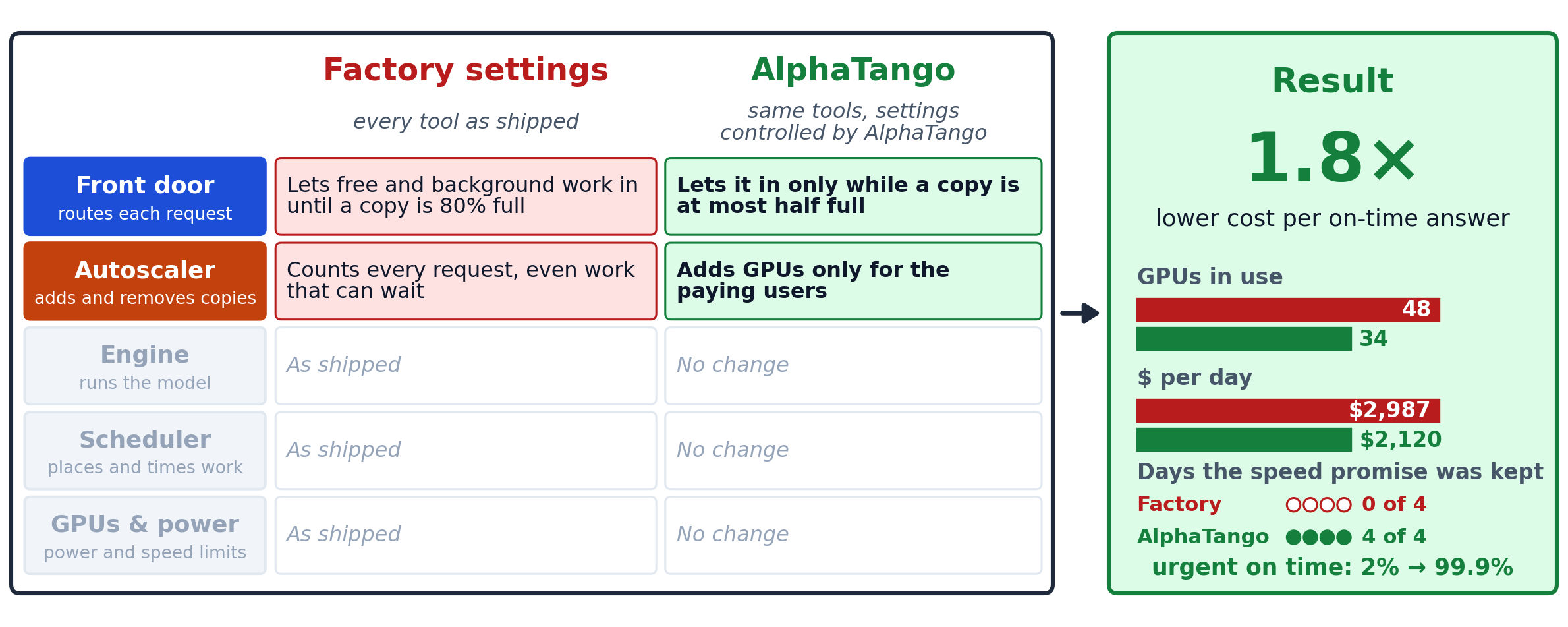
Paying users, free users and background jobs share your GPUs. At factory settings, background work crowded out urgent users: only 2% were answered on time. AlphaTango tunes two tools together: 99.9% on time, 1.8× lower cost per on-time answer, on 1.4× fewer GPUs.
Case 02 / Consumer AI
01Before / after
Simulation on public traffic, first unseen day (1.8× = 45% less). Over four unseen days: 1.7× to 1.9×.
02How AlphaTango wins
Local settings. Global goal.
Left: what every tool does at the settings its vendor ships. Middle: the settings AlphaTango changed, tool by tool, each kept only because the whole service got better. Right: the result.
03The story
Urgent answers on time: 2% → 99.9%, at 1.8× lower cost
For: Chatbots and assistants where paying users, free users and background jobs share the same GPUs.
The situation
Many AI services run urgent requests, such as paying users in a live chat, next to ordinary chat and background work that can wait hours, all on one pool of GPUs. At factory settings the front door (which routes each request) lets background work in whenever a running copy of the model is less than 80% full. Each copy then handles so many requests at once that answers arrive too slowly for urgent users: only 2% of urgent answers were on time. Meanwhile the autoscaler (which decides how many GPUs to run) counted the background work as demand and rented more GPUs, 48 on average.
What AlphaTango does
AlphaTango sets two dials on two tools from different vendors, together. The front door lets background work in only while copies are at most half full, so urgent answers stay fast. The autoscaler stops renting GPUs for work that can wait.
The proof
Urgent answers on time rose from 2% to 99.9%, on 34 GPUs instead of 48 (1.4× fewer). The daily bill fell from $2,987 to $2,120, and the cost per on-time answer fell 1.8× (45% less). Over four unseen days AlphaTango was 1.7× to 1.9× cheaper per on-time answer and kept the promise on all four, where factory settings broke it on all four. On another company's traffic: 2.4× cheaper.
Next step
Tell us how your users are tiered, and we will show you on your own traffic how to put them first for less.
The trade-off: background work waits until there is room. In this test most of it passed its 4-hour deadline and was dropped, because it was worth less than the GPUs it needed. On 2026 traffic, against factory settings first given the smallest fleet that keeps the promise, the saving was 24.5%.
04Watch
The case in 37 seconds.
Narrated walk-through of the situation, what AlphaTango changes and the result.
05More use cases