Size it before you buy it.
The AlphaTango Capacity Planner is a self-serve sizing tool. Describe your models and traffic, pick the GPUs you are considering, and it runs the whole thing on the AlphaTango Digital Twin: the answer is measured, not guessed. Six questions it answers in minutes.
01Six questions, answered
How many GPUs for my launch?
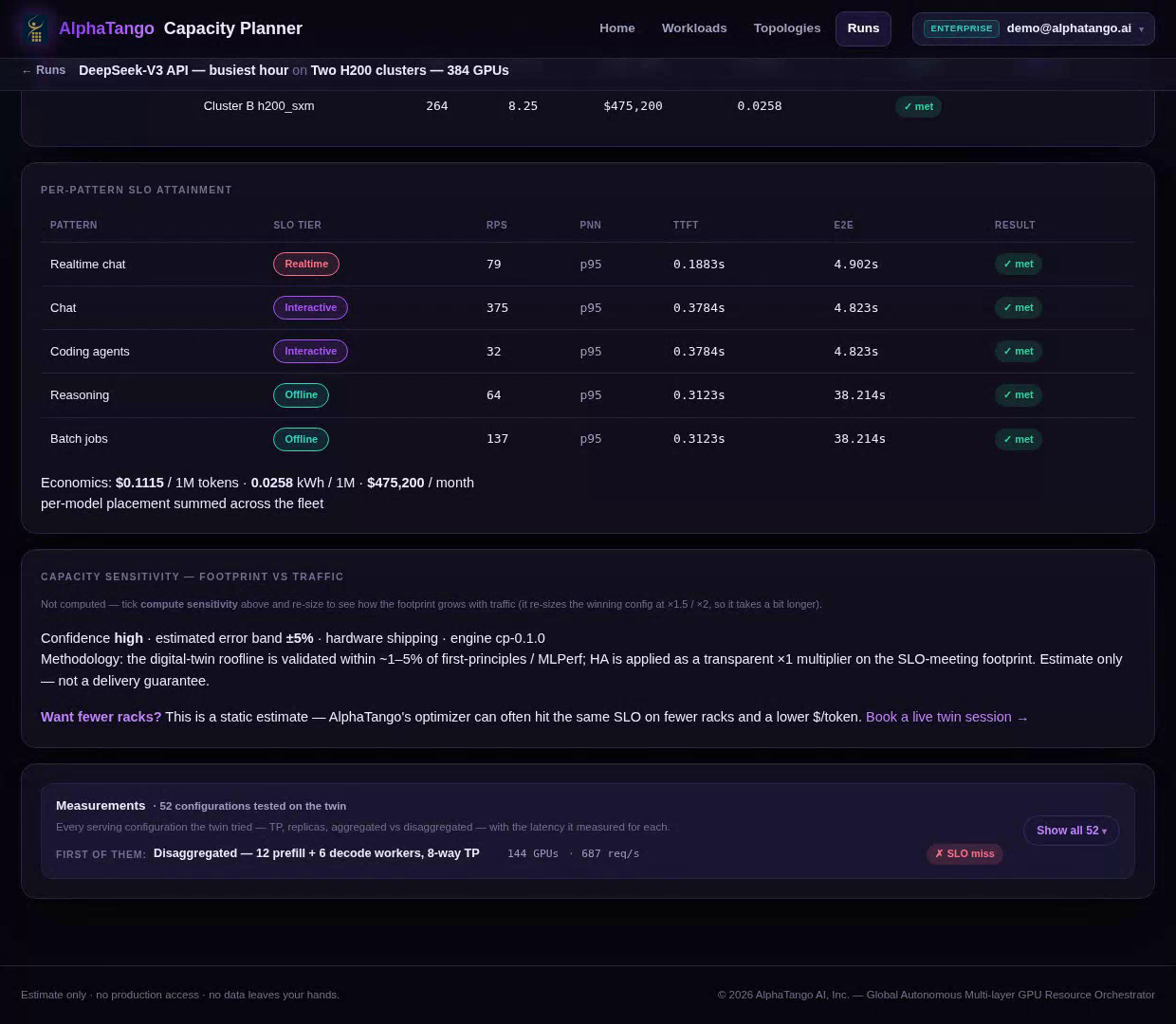
264 GPUs, every speed promise met. An API provider launching DeepSeek-V3 for five kinds of work, about 690 requests a second at the busiest hour. The Capacity Planner sizes it on two H200 clusters: 264 GPUs, every promise met.
See the demoWhich GPU should I buy?
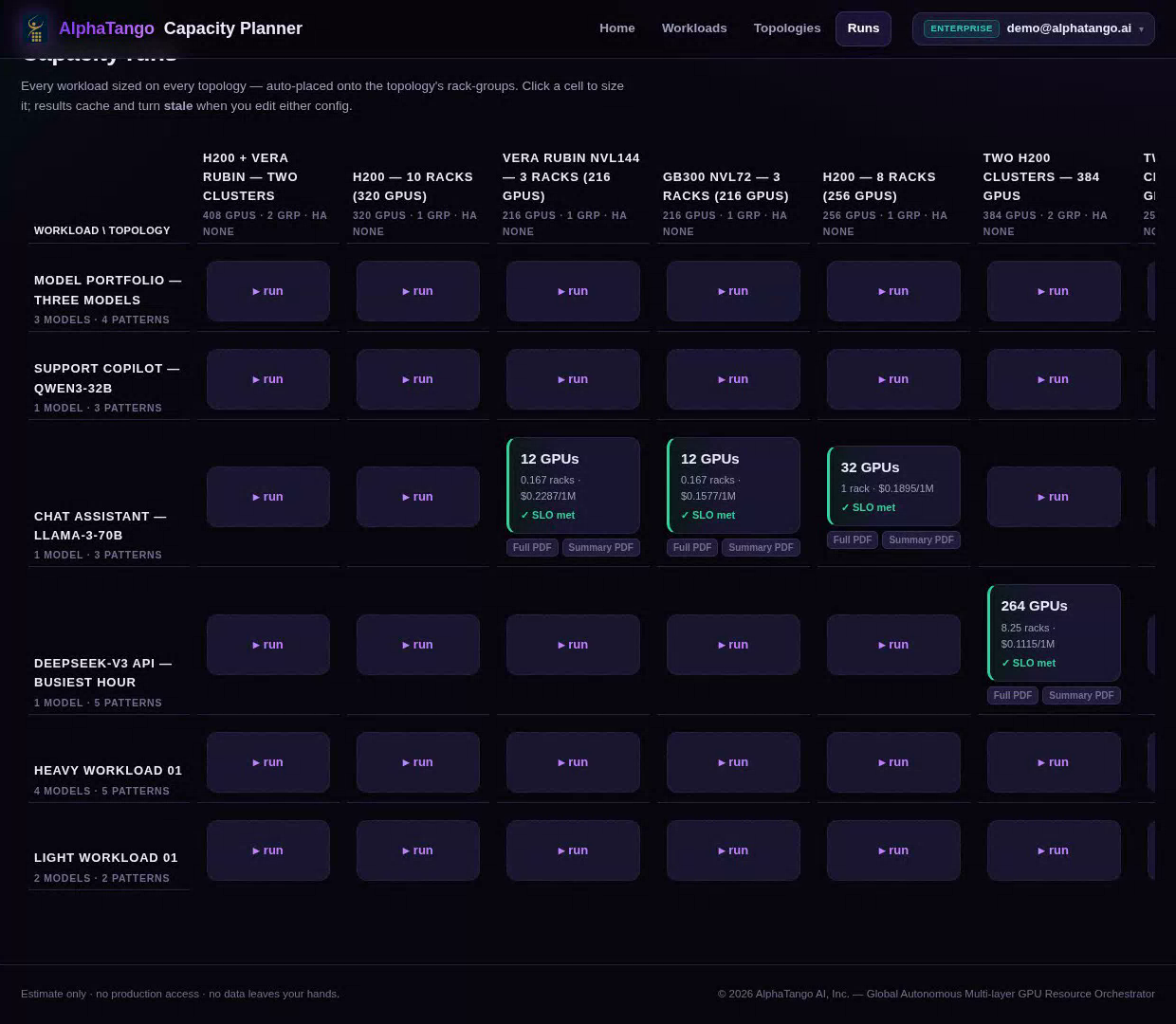
GB300: 12 GPUs, the lowest monthly cost. A Llama-3-70B chat assistant, 70 requests a second, sized on three GPU options. H200 needs 32 GPUs; GB300 NVL72 and Vera Rubin need 12 each, and GB300 has the lowest monthly cost.
See the demoWhat if my traffic doubles?
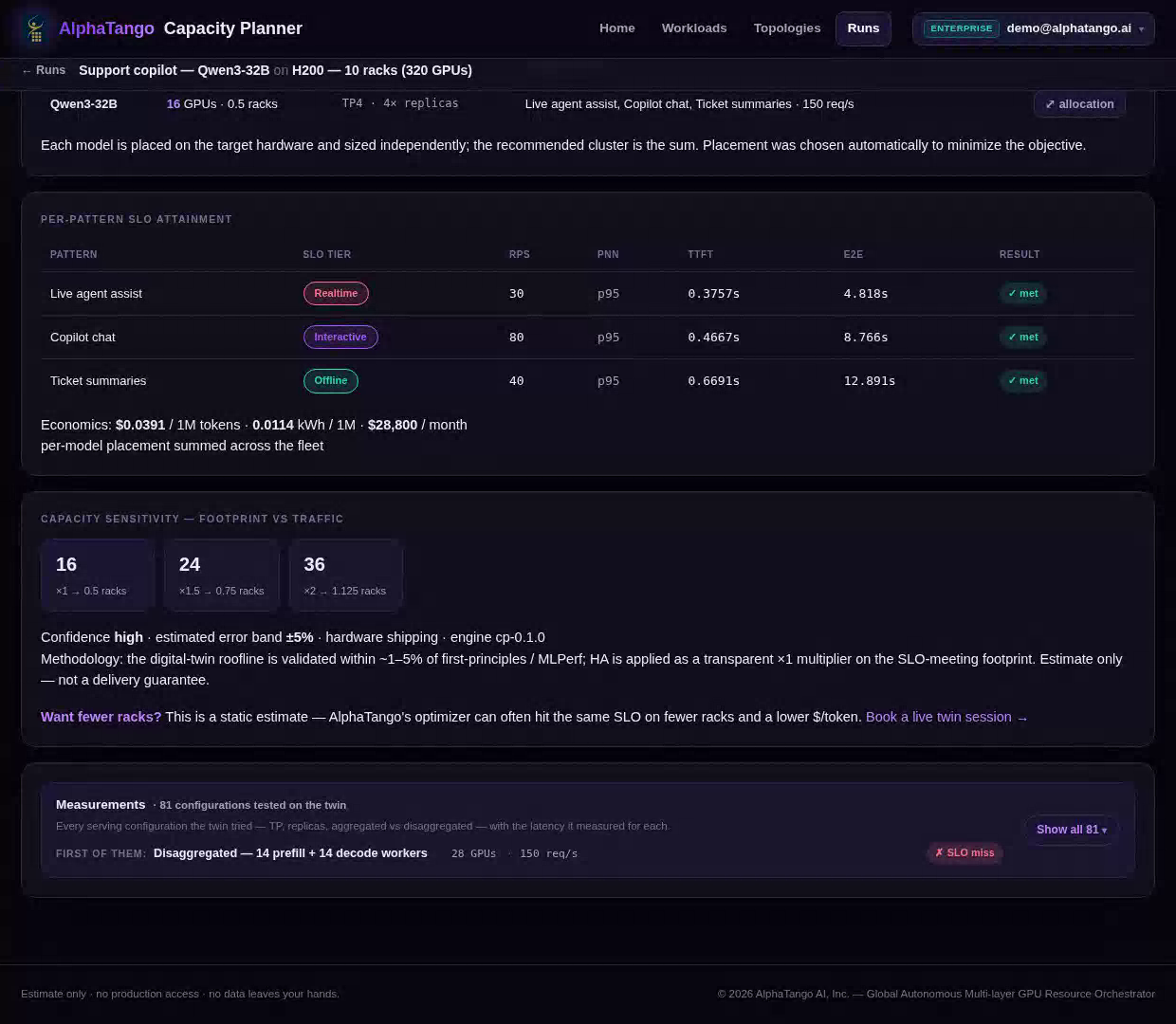
2× the traffic needs 2.25× the GPUs. A Qwen3-32B support copilot on H200: 16 GPUs today. The Capacity Planner re-sizes it for growth: 24 GPUs at 1.5× the traffic, 36 at 2×. Doubling the traffic takes 2.25× the GPUs, not 2×.
See the demoMany models, two GPU generations
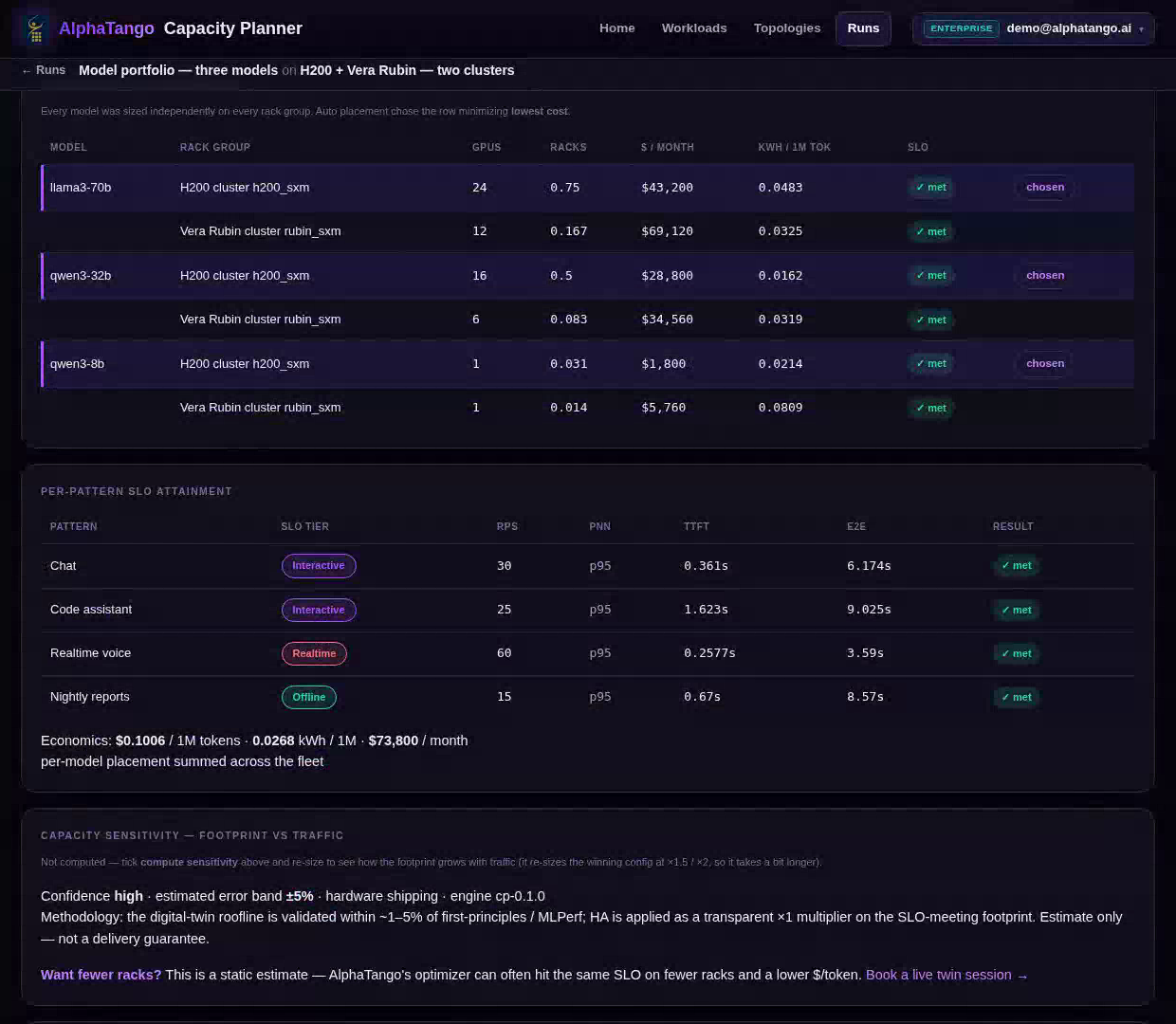
Rubin: half the GPUs. H200: the lower bill. Three models and two GPU generations. The Capacity Planner sizes every model on both: Vera Rubin needs half the GPUs or fewer, but at today's rental prices H200 is cheaper for all three, so that is where it puts them: 41 GPUs, every promise met.
See the demoWhat does reliability cost?
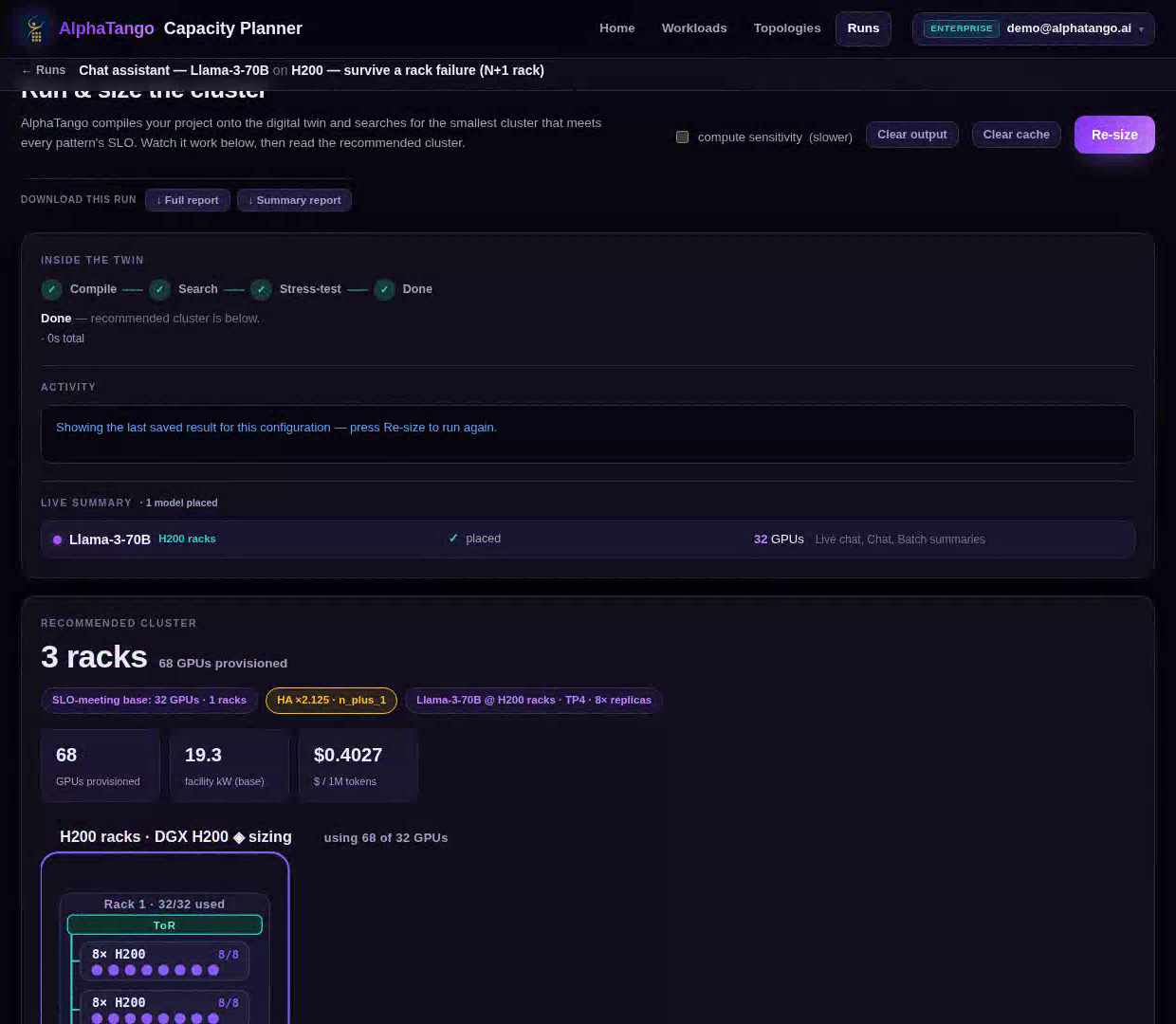
Surviving a rack failure: 2.1× the bill. The Llama-3-70B chat assistant needs 32 H200 GPUs, $57,600 a month. Surviving a server failure takes 44 GPUs ($79,200); surviving a whole rack failing takes 68 ($122,400). Know the price of each promise.
See the demoWhat fits in my power budget?
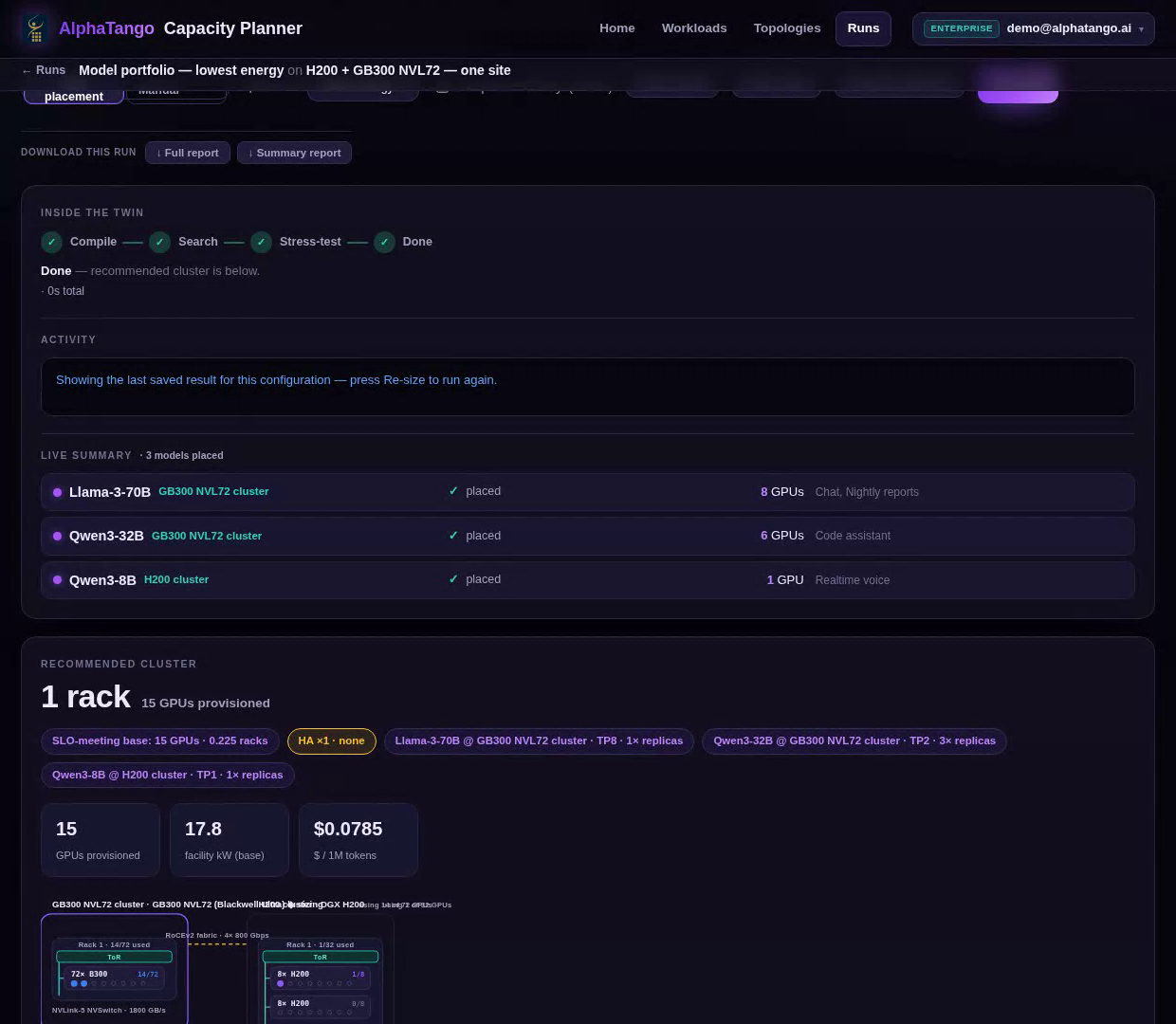
A third more work per megawatt. Three models on H200 alone: 41 GPUs, 23.6 kW. Add a GB300 NVL72 cluster and the Capacity Planner moves the two big models there: 15 GPUs, 17.8 kW, and a lower bill. A third more work from every megawatt.
See the demo